
Peripheral vision

Five developments that caught my eye:

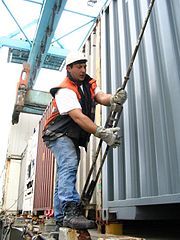
Weak link in the supply chain: West Coast ports

Many large U.S. companies have their products manufactured in China — no surprise there. But “the huge surge of goods arriving on our shores from China and elsewhere in Asia could easily overwhelm the infrastructure that receives and distributes them,” writes veteran consultant George Stalk.

Stalk — in his book “Five Future Strategies You Need Right Now” (Harvard, 2008) — calls this phenomenon the “China riptide” and makes this prediction:

The West Coast ports of the U.S. will reach their combined container unloading & loading capacity as early as 2010.

One researcher calls the ports “the choke valve” of global commerce.

Continue reading “Weak link in the supply chain: West Coast ports”

Improving the customer experience

Bruce Temkin, an analyst and blogger at “Customer Experience Matters,” provides a thoughtful set of definitions, below:

  • customer experience: the perception that customers have of their interactions with an organization
  • the perfect customer experience: a set of interactions that consistently exceeds the needs and expectations of a customer
  • customer experience management (CEM): the discipline of increasing loyalty by exceeding customers’ needs and expectations

There are three key elements of CEM:

  • discipline (ongoing activities, not slogans)
  • increasing loyalty (for profitability, not altruism)
  • customers’ needs and expectations “CEM is not about technology deployments or internal milestones. It needs to be calibrated from the perspective of target customers.”

The last phrase is worth repeating: “…from the perspective of target customers.” I’ve long maintained that good customer service occurs when the organization sees things from the customer’s perspective — OK, from my perspective!

Temkin warns that improving the customer experience is hard work. “CEM is easier to define than to do,” he says. You can download his (free) 11-page PDF booklet titled: “The Six Laws of Customer Experience.”

New safety hazard: Heads-down ‘texting’

We know about cell-phone-addled drivers, and wireless headset users who appear to be talking loudly to no one in particular. Now we have people typing furiously into their cellphones, BlackBerries and iPhones — heads down — and smacking right into poles or walls or other people.

Update: Forecaster Paul Saffo calls them “pedtextrians.”

A Chicago emergency room sees victims of texting incidents nearly every day, according to a Wall Street Journal article (25 July 2008). The fallen texters are prone to facial injuries, because they tend to hold the devices so close to their faces that their hands are less likely to break their fall. The common result: scraped chins, noses and foreheads (and broken glasses).

In London, some lamposts were outfitted with padded bumpers to cut down on injuries to errant texters (though it was a publicity stunt).

New England faces winter energy crisis

“Utilities and industry analysts estimate it will cost families 30% to 50% more to heat their homes with natural gas this winter,” the Wall Street Journal reports (18 July 2008). Worse: Families using heating oil — such as in New England — could face increases of 50% to 100%. People may end up paying $5 a gallon for heating oil this winter, a 72% increase over last year’s price, according to the Oil Heat Institute of Long Island.

It’s no longer just a problem for the elderly and poor; this time it will be a middle-class phenomenon, too. A colleague of mine (located in New Hampshire) says many New Englanders are just scraping by, paycheck to paycheck, and can’t afford the oil price hikes. They’ll resort to using kerosene space heaters, in unsafe ways. As a result, “some people will die this winter,” he predicts.

————-
Related:
Heating oil sticker shock to hit New England

Design a site like this with WordPress.com
Get started