

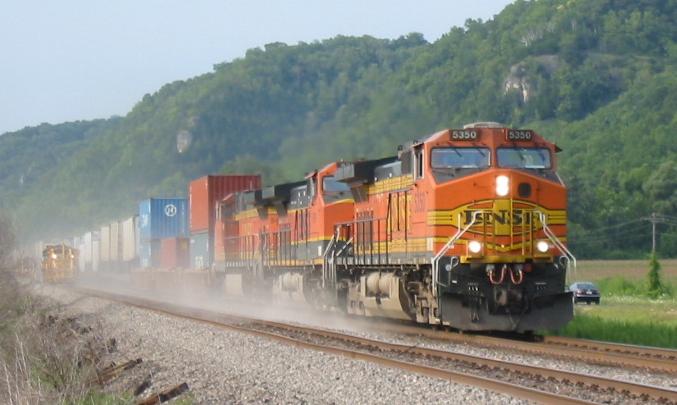
Railroads make eco-friendly comeback

Is the horse-drawn carriage next? It’s 2008 and the once-dying freight railway industry is “enjoying its biggest building boom in nearly a quarter century, a turnaround as abrupt as it is ambitious,” gushes The Washington Post ( 21 April 2008 ). The boom is “largely fueled by growing global trade and rising fuel costs for 18-wheelers,” the article says. However, with the boom comes a concern about a return to the robber barons (and anti-competitive pricing) of the 1800s. Excerpts:

In 2002, the major railroads laid off 4,700 workers; in 2006, they hired more than 5,000. Profit has doubled industry-wide since 2003, and stock prices have soared.

This year alone, the railroads will spend nearly $10 billion to add track, build switchyards and terminals, and open tunnels to handle the coming flood of traffic. Freight rail tonnage will rise nearly 90 percent by 2035, according to the Transportation Department. [Actually: 88%.]

[T]he changing global market has fueled prosperity — and the need to add track for the first time in 80 years. Soaring diesel prices and a driver shortage have pushed freight from 18-wheelers back onto the rails. At the same time, China’s unquenchable appetite for coal and the escalating U.S. demand for Chinese goods, means more U.S. rail traffic is heading to ports in the Northwest, on its way to and from the Far East.

The zeitgeist has even dropped a “green” gift in the industry’s lap. A train can haul a ton of freight 423 miles on one gallon of diesel fuel, about a 3-to-1 fuel efficiency advantage over 18-wheelers, and the railroad industry is increasingly touting itself as an eco-friendly alternative.

But rail customers are complaining about the kind of price-gouging not seen since the robber barons of the 1800s, leading to antitrust suits and calls for re-regulation of rail prices. The rail industry counters that it’s using the same kind of “differential pricing” that airlines use today (i.e., higher prices where they have market power).

———–
Related:
Railroad news: Shippers say lack of antitrust enforcement hindering rail competition

Food inflation is leading to food riots

Global food prices are up 83% in the past three years, putting huge stress on some of the world’s poorest countries, notes a recent Wall Street Journal article ( 14 April 2008 ).

Rioting in response to soaring food prices recently has broken out in Egypt, Cameroon, Ivory Coast, Senegal and Ethiopia. In Pakistan and Thailand, army troops have been deployed to deter food theft from fields and warehouses.

World Bank President Robert Zoellick warned in a recent speech that 33 countries are at risk of social upheaval because of rising food prices. Those could include Indonesia, Yemen, Ghana, Uzbekistan and the Philippines.

Some countries say the U.S. appetite for biofuels is part of the problem.

“When millions of people are going hungry, it’s a crime against humanity that food should be diverted to biofuels,” said India’s finance minister, Palaniappan Chidambaram, in an interview. Turkey’s finance minister, Mehmet Simsek, said the use of food for biofuels is “appalling.”

The U.S. government notes that biofuels are only one contributor to rising food prices. Rising prices for energy and electricity also contribute, as does strong demand for food from big developing countries like China, the article said. Aggravating the problem, in some countries food inflation has prompted a wave of protectionism — in essence, trying to keep more food in their country by restricting exports. Also, some countries are boosting consumer subsidies and instituting price controls.

————
Related:
The price of rice is sky high
Riots, instability spread as food prices skyrocket
Haiti’s government falls after food riots

Maybe what we need is a Financial Services Corps

Melissa Koide, an analyst at the New America Foundation, has an interesting idea for helping low- and middle-income American households make more-informed financial decisions. The idea is to create a Financial Services Corps of financial advisors to counsel households on today’s rather complex financial landscape.

The policy proposal has four key elements:

  1. Enlisting financial experts and advisors to deliver personalized financial counseling and planning to low- and middle-income households;
  2. Providing the tools, resources, support to local, regional, and workplace-based initiatives to ensure these families are effectively reached;
  3. Collecting & analyzing data to understand the short-, medium- and long-term financial education, counseling and planning needs of these households; and
  4. Exploring new strategies and approaches to financial education & advice — through an innovations fund.

I have a few concerns, such how to make sure the financial advisors provide unbiased advice, i.e., not biased towards certain investment strategies where the advisor has a conflict of interest (e.g., gets a commission). I also wonder whether this will be a magnet for lawsuits, filed by families upset that the well-meaning advice ended up losing them money.

But I applaud the fresh thinking that went into this. It’s an improvement over the Bush administration’s volunteer initiative for financial literacy.

Continue reading “Maybe what we need is a Financial Services Corps”

Business greetings: Shake hands, kiss cheek(s) or make smacky noise in the air?

One effect of globalization: learning whether to shake hands, kiss, or kiss-kiss-kiss when greeting a business associate from outside the U.S. “With so many national customs involved, ordinary office greetings require savoir-faire,” says Wall Street Journal writer Christina Binkley ( 27 March 2008 ) .

There was a time when business acquaintances did not kiss lightly on our side of the Atlantic. Close friends and family, maybe — but one didn’t peck her investment banker on the cheek or buss his Congresswoman. Social greetings are evolving, though, and are becoming more complicated with globalization.

Whatever happened to shaking hands? There is something so American about the firm control of a handshake — it’s about disarming one’s opponent and keeping him two feet at bay. Control is in our DNA. This is why travel guides must spell the social kiss out for us: In France, generally two cheeks, or four, no lips; in parts of Belgium, three cheeks, and so on.

Still, raise the subject and a blush-worthy anecdote is sure to follow. “Much of the confusion comes because each participant assumes he or she is choosing the type of social kiss to be performed, and the two choices don’t match,” writes Judith Martin, a.k.a. Miss Manners, in her “Guide to Excruciatingly Correct Behavior — Freshly Updated.”

Miss Manners says to kiss the right cheek first. “The first presenter gets to choose whether they will actually kiss each other’s cheeks, make a smack-smack noise in the air, or simply bump cheeks,” she writes. “The partner’s job is still to be alert in order to follow suit….” More rules are here (in a sidebar).

And, in case you were wondering, the rule is “no frontal hugs” in business settings. Major faux pas.

Wall Street analysts still hyping their stock picks

Wall Street analysts are painting an awfully rosy picture of earnings growth, according to a study done by Penn State researchers. “[T]heir long-term earnings-per-share growth-rate forecasts are excessive and upwardly biased,” says J. Randall Woolridge, a professor of finance at the Smeal College of Business.

Over the period 1984 to 2006, analysts’ predicted EPS growth at an average of 14.7% for the long term (three to five years). Actual EPS growth: 9.1%.

On one-year forecasts, analyst projections fared a little better, but they were still overly optimistic: 13.8% instead of the actual rate of 9.8%.

So why is this happening?

  • Analysts’ employers want them to hype stocks so the brokerage can win commissions and underwriting deals. “This conflict of interest should have been squelched by former New York Attorney General Elliot Spitzer’s investigation and the $1.5 billion payment made by U.S. investment firms in the 2003 Global Analysts Research Settlements (GARS).” But the study found that GARS had no effect; analyst forecasts remained at their historic levels of about 15%.
  • Analysts don’t issue forecasts on stocks they don’t like.
  • Analysts becoming attached to the companies that they follow and, as a result, lose objectivity.

———–
Related:
Most companies fail at forecasting earnings
The fallacy — and cost — of giving quarterly earnings guidance

Design a site like this with WordPress.com
Get started